Thursday, September 25, 2014

Louis Morris representative of New York

During the time of instability between Great Britain and the Americas in the aftermath Indian and French War came many taxation due to the expensive endeavor of of war; consequently a extra-legal conference came to be in between delegates of the Americas to oppose such taxation. On July 1, 1776, the Second Continental Congress met in Philadelphia, these states included New Hampshire, Massachusetts, Rhode Islands, Connecticut, New York, New Jersey, Pennsylvania, Delaware, Maryland, Virginia, North and South Carolina and Georgia. In this meting of independence there was total of Fifty-six delegates signed the United States Declaration of Independence, a statement announcing that the thirteen American colonies were now independent states, and thus no longer a part of the British Empire. These delegates were chosen due to the superb reputation and experience each acquired; one of the many delegates being Louis Morris representative of New York. Morris was elected as one of representative of New York the in Second Continental Congress due to his well standing social status knowledge of politics and his unbiased assessment. 

Louis Morris, born in New York, was born into a high ranking family who were both wealthy and politically involved thus setting up Morris whole future to be invincibility in the direction of politics. Morris came from an influential political family in New York politics who owned the land that is now in the Bronx and the city of Morrisania that was later inherited by Morris with the death of his father and controlled the estate. While his political future was set in stone when he graduated from Yale College in 1746.  He served in the Provincial legislature before the troubles with Great Britain began and joined with the patriots. With his 
high ranking education and family pedigree Morris gained a sturdy place in New York politics and ideal receptive for New York in the Continental Congress. Morris was also an advocate for the poor often siding against his wealthy neighbors and was known for his strict morality, uncommon dignity and graceful demeanor. Thus he's morality was one desired by the New York citizens to represent them in this all important meeting discussing the fate of the Americas in regard to the tyranny of Great Britain. 

Due to Morris outstanding family line, education and fair ruling his place in the Continental Congress and signing of the Declaration of Independence was both well earned and inevitable. As well as his later contribution in  as a brigadier-general in the New York militia that brought conflict between his duties in congress and to the defense of his own colony.  In 1777 he returned to his local duties, served as a judge in Worcester, and served intermittently as a member of the upper house of the new legislature until 1790. As well as rebuilding his estates that was destroyed in the revolution;(which Lewis Morris had three sons that served in the Continental Army during the Revolutionary War) the he later  died in January 1798 at the age of 72.


Wednesday, September 10, 2014

Did Pocahontas save John Smith? I think not.

Though historical context there is a blur of the actual encounter of John Smith and native Pocahontas. Whether the iconic heroic act of Pocahontas to save John Smith from her enraged father, Chef of the Powhatan tribe, was more then just a myth. At the time English were beginning the act colonizing the Americas quite late in the game compared to the Spanish and  Portuguese, in the 1600's. In which they encountered conflicts amoungst natives through bloody wars in the few colonies such as, the first surviving settlement of the English, Jamestown whose ruler was John Smith due to his ability as a captain and later wrote experiences in the Americas in England that quite differed. This Inconsistency of documentation provides this level of hearsay that discredits the works of John Smith. Thus Pocahontas did not save John smith due to the the inconsistency of written statements and the later documentation of Pocahontas by Paul Lewis discrediting the "saving" story which was just that a story.

The events that transpire in the aftermath of John Smith captivity of the natives blur in the time rage of 1607- 1624 along with secondary view that clears the overall "encounter"  John Smith, governor of Jamestown and captain, documented his experience with Powhatan in 1607 depicting the natives a kind and generous in the True Revelation; document A. This document is the primary recording of the Natives toward John Smith himself. While Smith later changed his perspective in General History(Document B) in 1624 his published work is prone to influence resulting in false events required by Smith. Later seen in Paul Lewis sum up the actual events that transpire. Thus all documents prove that the interaction between Pocahontas and John Smith never happened.

Tuesday, August 19, 2014

The Portuguese and Spanish Impact to the Americas

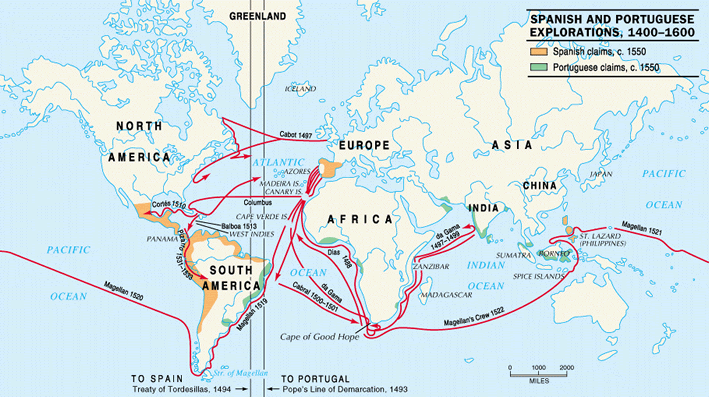
The Portuguese and the Spanish were the first to colonize in the Americas from the old world, taking over and claiming lands and interacting with natives. Exchanging resources, ideas/religion, and of course disease; thus causing the early years of colonization being a deadly one and was later greeted with mistreatment and enslavement of the same natives that greeted Europeans with hospitality. The Spanish and Portuguese brought forth the colonization of the new world and a the harsh introduction of a new religion Christianity, through inhuman ways. The arrival of the Portuguese in the Americas paved the way for the america known today from its colonization to religion ans well as way of life, through the extreme extent of colonization, the introduction of religion as well as the extermination of another and the crops and livestock brought over by Portuguese and Spanish.

The Portuguese were the fist to develop ships fit to travel the harsh currents of west-bound winds and be able to venture outward. While the Spanish stumbled into the Americas treasures accidentally in search of a new trade route to the indies where commerce and trade was highly profitable. Yet found the Americas and went on to colonization when the discovery of a new land was realized. Started immediately into colonization and exploiting everything the Americas had to offer.The Portuguese and the Spanish both shared one major goal: wealth. That they acquired with settlement in the Americas, due to rich soil, profitable metals(gold, silver etc) and a blank canvas; however not so blank. Natives/"Indians" (Due to mix up between trade routes) spread throughout the land, that proved a nuisance to incoming settlers that wanted to claim the land for the self's. Colonization did not serve to be such a problem due to the drop of population of natives caused by disease (small pox, measles, syphilis)  brought by the Spanish and settlers, thus natives were earlier to control. Yet this did not stop revolts amoungst natives, yet unfortunately were unsuccessful, but brought better treatment from settlers. Apart from treatment the Portuguese and Spanish also had trade in common. Well the mainly Portugal who traded spices, gold and sugar cane, which made up most of their profit with the prosperity of sugar plantations. While the Spanish mainly relied on slavery from the natives allowed via the encomienda system. Which allowed the right to demand tribute and forced labor from the Indian inhabitants of an area and put the spanish on a golden pedistle about saving natives from there savage lifestyle and beliefs; however Bartolome de Las Casas (1474-1566). Who spoke against the church (saying alot due to priest status) and the Spanish actions in the natives in the Americas. As well as giving the voiceless a voice, he provided the world a written report of time, which was hard to come by at the time period.

As the Portuguese and Spanish conquered the Americas and underwent rapid colonization the Treaty of Tortillas was developed. Which divided the Americas by the catholic church; west of the land to the Portuguese and north of the land to the Spanish. While this evaded conflicts between the Portuguese and Spanish it brought no consideration to natives whose say deserved no needed to be heard and considered. However among st these tragedies the triangle trade took birth into a more elaborated triangle trade wholes wing span expanded the whole world. Into an essential part of the economy thriving the profits and the value of the Americas and building the bones of a future World power on the bones of natives and there traditions. These trade networks mirror those used today, as well as our diets connect the the resources brought over from the Old world to the New; as well as religion of these times still influencing our modern day world and societies. Thus illustrating the impact of the Portuguese and the Spanish on the Americas and the Modern day world.  

Spanish and Portuguese Expatiation 1400-1600


Spanish Impact of the Americas


Friday, June 27, 2014

Abraham Lincoln : Historical Figure worth Admiration

Abraham Lincoln : Historical Figure worth Admiration


Throughout my academic experience one historical figure has always stood out: Abraham Lincoln. For his just deeds and humble beginnings, he was truly a perfect picture of a worthy leader. His cadency brought forth a civil war; however the outcome was in the form of a step closer to a better country with correct morals. Despite Lincoln's harsh childhood, losing his mother at a young age, he persevered towards the only thing that would bring benefit to himself, education. Rather then letting this tragedy be a scapegoat for his failure, on the contrary he taught himself law. Not soon after that he took a interest into politics and ran for presidency. It is because of these traits that shaped Abraham into not a man of excuses but one of actions. His
charismatic personality did not hurt either. Wherever Lincoln would speak everyone listened, this made him a shoe in for president. It is these traits that gain my praise for Abraham Lincoln. He was man of action and amazing leadership skills; that could move people with his speeches. He stood up for his ideologies till the end regardless of the outcome; for better good of a nation or in this case a union.


Abraham Lincoln was a man of values and notion of right and wrong. Whose most famous deed was that of the liberation of the group people whose rights were being denied; the abolishment of slavery. That is seen through the document: The Emancipation Proclamation. Which proclaimed that all slaves were freed; however this was just in a warring state. Thus not permanent, this deed was later legalized with addition of the thirteen amendments to the bill of rights. That includes the famous rights of freedom of expression including speech, press including assembly and of cause religion along with other amendments. However his liberalist opinion soon came at a cost, with the supremacist propaganda of the time taking over. Naturally he gained enemies, partially those in the south; who depended on slavery for a prospering economy. This eventually led the sedition of a large number of confederate states. That led to a civil war, that incially was an attempt to keep the union in one piece. That eventually turned to fight of right and wrong, a final decision to the morals of a nation that had grown tied of decision of compromise. Yet as almost out of a storybook right won; leaving the United States of America a free country. However reality soon kicked in with the assignation of one of America's greatest presidents, due to primal ideas and an enigma of "doing right". President Abraham Lincoln was murdered in cold blood.


Though his second presidential rain ended bloody, with his murder in April 14,1865. Abraham Lincoln left more then just his body but his legacy as well. Not only did Abraham Lincoln
abolish the idea of slavery, but also kept the union in one piece. Thus keeping the United States as the name implies untied. His life story is awe inspiring, something that gives me and I hope others promise. A promise of becoming something great, regardless of your background or setbacks. That us as individuals can leave our fingerprints on the world and inspire others to do the same. Thus Abraham Lincoln, in my opinion, is the a historical figure that demands recognition for his resilience, bravery and perseverance.